




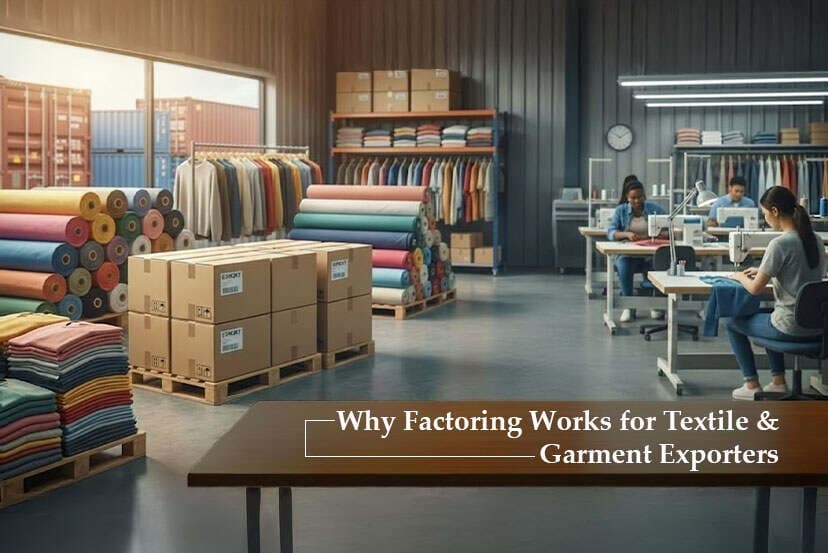
The garment and textile export business is always under financial pressure. The long production cycles, fluctuating cost of raw materials, logistics that are compliance-centered, and long overseas payment terms are some challenges. These make the management of liquidity an everyday challenge. Cash flow gaps are frequent even with the profitable exporters, just because the revenue is realized much later than the shipment schedules. That is why factoring for textile exporters has now turned into a popular financing tool in the world’s apparel supply chains.
Factoring is built around trade reality rather than balance-sheet assumptions. It converts receivables to liquidity immediately, enabling exporters to operate, compete, and grow without having to wait months to receive payments from buyers.
The Structural Cash Flow Gap in Textile and Garment Exports
Exports of textiles and garments are usually executed on an open-account basis. In the US, the EU, and other mature market buyers, credit periods are between 60, 90, and up to 120 days. While such terms are essential for winning export orders, they place sustained pressure on the working capital of textile exporters.
The exporters are required to fund the purchase of the yarn, processing of fabrics, dyeing, sewing, quality inspection, packing, transportation, insurance, and registration long before the payment is received. This spread binds the liquidity and restricts the exporter from taking up new orders, investing in capacity, and dealing with seasonal peaks. Over time, working capital constraints in textile exports become a structural barrier to growth rather than a temporary operational issue.
Why Bank Finance Often Fails Textile Exporters
Textile exporters have traditionally relied on bank-based export finance products. However, these solutions often struggle to align with the operating realities of garment exports.
- Rigid Structures That Ignore Trade Cycles
Bank loans follow fixed repayment schedules that are not linked to buyer payment behaviour. Exporters are required to service EMIs even when overseas buyers delay payments. This mismatch between cash inflows and loan obligations makes the comparison of factoring vs. bank finance increasingly relevant for textile exporters.
- Collateral and Limit Constraints
Banks typically require collateral, margin funding, and predefined credit limits. As export volumes grow, these limits often become restrictive. Exporters with fluctuating or rapidly changing order books are unable to revise limits frequently enough to support business expansion.
- Operational Friction
Documentation-heavy processes, slow approvals, and conservative risk assessments reduce responsiveness. This lack of agility can be costly for exporters operating in fast-moving production cycles, where timing and liquidity are critical.
How Export Factoring Works in the Textile Industry
Export factoring in the textile industry focuses on post-shipment receivables. Once goods are shipped and invoices are raised, the exporter sells these receivables to a factoring partner. A large portion of the invoice value is released in advance, typically within a few days.
The factoring partner then manages collections from the overseas buyer at maturity. This structure provides exporters with accounts receivable financing without adding debt to the balance sheet. Liquidity improves immediately, while buyers continue to follow their original payment timelines without disruption.
Why Factoring Is Especially Effective for Textile Exporters
- Liquidity Linked Directly to Sales
With invoice factoring for garment exporters, cash flow is no longer constrained by the buyer’s credit period. Funds are released shortly after the sale is completed, allowing exporters to reinvest continuously in production and operations.
This is particularly valuable in the garment export industry, where order volumes fluctuate, and seasonality plays a significant role.
- No Dependency on Fixed Assets
Factoring is transaction-driven rather than asset-driven. This makes export finance accessible to MSME textile exporters who may lack substantial fixed collateral but maintain strong and reliable buyer relationships.
- Automatic Scalability
Factoring limits naturally expand as export volumes grow. Garment export factoring supports business growth without the need for frequent limit renegotiations, making it a flexible and scalable financing option.
Managing Buyer Credit Expectations Without Cash Flow Stress
Global buyers increasingly expect extended credit periods. Factoring enables exporters to offer competitive payment terms without bearing the full financial burden of delayed collections. By converting receivables into immediate liquidity, factoring stabilizes working capital for textile exporters while preserving commercial competitiveness.
This balance is essential for retaining large buyers and maintaining operational and financial health.
Factoring as a Risk Management Tool in Global Trade
Certain factoring structures also offer buyer default protection. This strengthens trade financing for exporters operating in volatile global markets by reducing exposure to non-payment risks.
For exporters entering new markets or onboarding new buyers, risk mitigation is as valuable as liquidity itself.
- Operational Benefits Beyond Funding
Factoring is better than cash flow. It increases the financial discipline, streamlines the receivables management, and decreases administrative overhead. Which means exporters do not need to waste time in the pursuit of payments but rather in sourcing, production, and interacting with buyers.
Over the long term, these efficiencies strengthen textile export working capital management and improve overall business resilience.
Factoring vs Bank Finance for Textile Exporters
When comparing factoring vs bank finance for textile exporters, it is clear that:
- Factoring aligns funding with invoice maturity, while bank loans follow fixed repayment schedules.
- Factoring scales naturally with sales growth, whereas bank finance remains limit-bound.
- Factoring relieves pressure on the balance sheet, while bank loans increase leverage.
Factoring is especially beneficial for exporters with long receivables cycles, as it provides timely and flexible liquidity support.
Why Garment Exporters Prefer Factoring Over Loans
Garment exporters work under strict delivery time limits and lean margins. Any delay in production due to cash shortages can lead to penalties or even order cancellations. Invoice factoring for garment exporters helps eliminate this risk by ensuring continuity of liquidity throughout the production cycle.
Since factoring expands and contracts in line with export volumes, it effectively finances peak seasons without putting repayment pressure on exporters during slower periods.
Digital Transformation in Export Factoring
Modern platforms have significantly transformed export factoring for the textile industry. Automated invoice verification, buyer risk assessment, and faster disbursements reduce processing time and operational friction.
Digital factoring improves transparency, minimizes paperwork, and enables exporters to plan cash flows more accurately and confidently.
Choosing the Right Factoring Partner
An appropriate factoring partner must be aware of the textile trade cycles, buyer behavior, and export compliance regulations. Experience in apparel exports plays a critical role in delivering consistent export finance to textile exporters without disrupting their day-to-day operations.
Strategic Takeaway for Textile and Garment Exporters
The textile and garments exporters cannot afford the liquidity uncertainty in the competitive market around the world. Factoring for textile exporters not only turns the receivables into working capital, but it also matches financing to trade cycles, as well as eliminates reliance on inflexible bank systems. Factoring can effectively serve as a strategic tool instead of a temporary solution since it helps to grow without collateral requirements.
Credlix provides textile and garment exporters with digital export factoring solutions designed around real trade cycles. By unlocking cash tied up in export receivables, Credlix enables exporters to maintain uninterrupted production, offer competitive buyer credit terms, and expand into international markets without cash flow disruptions. With deep expertise in trade finance, Credlix is committed to supporting exporters in achieving sustainable, long-term growth.
FAQs
Q1: Why is factoring better than regular loans to the exporters of textiles?
Since factoring allows matching of funds with the realization of invoices as opposed to the set repayment schedules, factoring is more efficient in long export credit cycles.
Q2: Is it possible to use factoring to serve exporters who have many foreign buyers?
Yes. Factoring scales across buyers and markets. Provided that invoices are verifiable and trade-compliant.
Q3: Does Export factoring increase the balance-sheet debt?
No. Factoring is receivables-based and does not contribute to long-term debt, which enhances better balance-sheet efficiency.