



Every export deal comes down to some uncomfortable questions, such as when the payment will be made and how much control the seller keeps over the shipping paperwork. The gap between the day the container is shipped and the day the money lands is where export payment terms come into play.
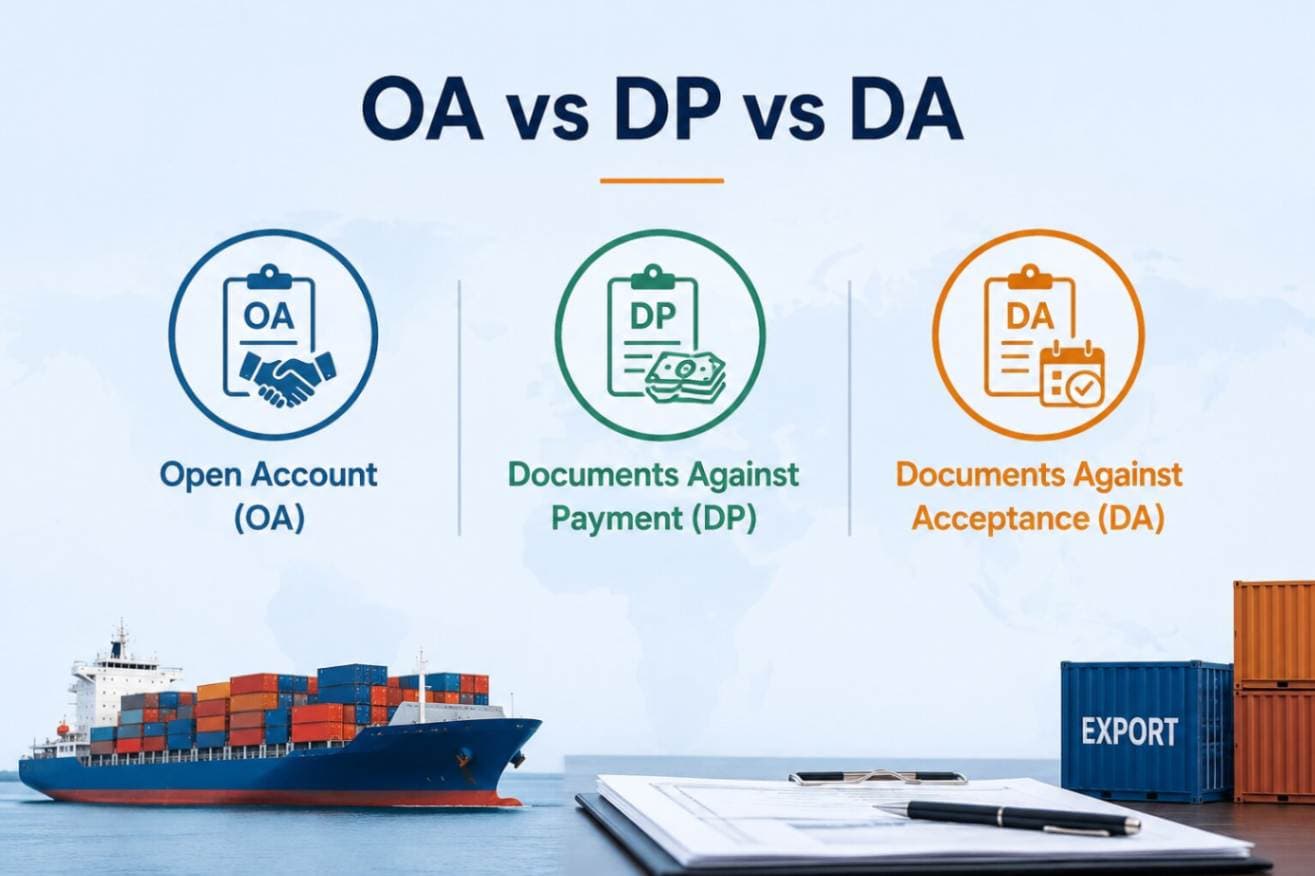
Exporters are often in a dilemma about how the payment will work out. If they ship first and trust the buyer to pay later, they are using their own working capital to finance their business. If they insist on getting paid before the documents are released, they may end up losing the order to a competitor who agrees to later payments. Somewhere in between these scenarios, Indian exporters negotiate some common payment terms every day. These are: Open Account (OA), Documents Against Payment (DP), and Documents Against Acceptance (DA).
Each term works differently, which means it is important for exporters to learn the distinction between Open Account (OA) vs Documents Against Payment (DP) vs Documents Against Acceptance (DA) before you discuss the deal with the buyer. With the right information, you can decide which term you can offer and protect your cash flow.
What is an Open Account (OA)?
An open account payment in international trade is an arrangement in which the buyer receives the goods shipped by the exporter first, and then makes the payment at the end of the credit period that was mutually agreed to. This can be 30 days, 60 days, 90 days, or more.
In this scenario, there is a significant gap between the date of receipt of the purchase order and the date of receipt of the payment. Within this timeframe, production and shipping are concluded.
The time gap in open account payment strains the working capital situation for the exporter. So, why do exporters opt for open account (OA) payment terms? If the importer is a strong and reputable one or if there is a chance of high order volumes in the future, the exporters can handle the longer payment window.
Understanding a Documentary Collection
The documentary collection payment method is one in which both the importer and exporter involve their respective banks to facilitate the transaction. The exporter’s bank is known as the remitting bank while the importer’s bank is known as the collecting bank.
Documentary collections in international trade are of two types: documents against payment (DP) or documents against acceptance (DA). Here’s what they mean:
- What is Documents Against Payment (DP)?
Also known as Cash Against Documents (CAD), DP is the payment term in which the buyer needs to make the payment immediately when the shipping documents are presented.
The buyer makes the payment before the collecting bank releases the documents. So, documents against payment or DP ensures that the importer has made the payment before they get possession of the goods sold. The DP transaction utilizes a sight draft, which means the payment is made on demand.
- What is Documents Against Acceptance (DA)?
The DA payment term in export is an arrangement in which the buyer makes the payment only after a specific duration. The DA transaction utilizes a term or time draft. Next, the buyer accepts the time draft and promises to pay.
The bank releases the shipping documents to the buyer only after the buyer accepts a time draft drawn upon them. Usually, DA terms specify a future maturity date, such as “90 days after sight,” meaning payment is due 90 days after the draft is presented/accepted, or “150 days from the bill of lading date,” where the maturity is calculated from the bill of lading date.
Difference Between OA, DP, and DA: How the Three Payment Terms are Distinct
There are many parameters that differentiate Open Account, Documents Against Payment and Documents Against Acceptance (DA). The table below discusses them so that you can decide which one best suits your needs and scenario:
| Parameter | Open Account (OA) | Documents Against Payment (DP) | Documents Against Acceptance (DA) |
| What it means | Goods are shipped first, and the buyer makes payment at the end of an agreed period. | A type of documentary collection where documents are released only after immediate payment. | A type of documentary collection where documents are released once the buyer accepts the time draft. |
| Instrument used | None | Sight draft (bill of exchange payable on demand) | Time draft/term draft (payable at a future date) |
| Control of goods | Buyer has total control immediately. | The exporter/ seller retains control of the documents, and those documents may provide control over delivery of the goods | The documents are released after acceptance of the draft, allowing the buyer to obtain the goods while payment remains due at maturity. |
| Bank involvement | Minimal; banks only handle the fund transfer. | Remitting bank (of the exporter) and collection bank (of the importer) act as the intermediaries. | Remitting bank (of the exporter) and collection bank (of the importer) act as the intermediaries. |
| Timing of payment | After delivery (typically 30 to 90 days later). | At sight (immediately upon document presentation). | Deferred (on a future maturity date after draft acceptance). |
| Exporter risk | Very high (relies completely on the buyer’s promise of payment). | Moderate (the buyer may refuse to pay for or take up the documents when they are presented, leaving exporter with no options other than paying return freight or discounting the goods locally). | High (relies on a time draft and buyer solvency at maturity). |
| Flexibility (importer advantage) | Maximum cash flow and flexibility. | Limited flexibility (requires immediate capital outlay). | High flexibility (gets goods before making the payment). |
| Does the bank guarantee payment? | No | No. The remitting bank cannot assume liability if the buyer dishonors the sight draft. | No, unless the collecting bank separately provides a payment guarantee or aval. |
| Financing options for the exporter | Export financing, invoice discounting, and post-shipment finance. | Bill discounting (the draft can be sold to a bank at a discount). | Bill discounting or avalisation (the accepted draft is a discountable instrument). |
| Use case (for exporters) | Long-term, highly trusted partners. | New or developing trade relationships. | Established, creditworthy buyers. |
| Buyer’s preference | Most favorable to the buyer. | Least favorable to the buyer. | Middle ground (credit period without upfront payment). |
Maintain a Good Working Capital Despite the Payment Terms Chosen With Help From Credlix
An understanding of OA, DP, and DA makes one thing clear: the term that is beneficial for the buyer is also the one that brings maximum strain for the exporter. When exporters experience challenges in maintaining their cash flow, trade financing comes to the rescue. Credlix offers trade financing solutions for exporters against their shipped invoices, providing funds worth up to 90% of the invoice value. Instead of negotiating better terms with the fear of losing a buyer, you stop waiting for them and unlock working capital with the help of our solutions.
For example, if you have agreed to the open account payment term for international trade with a 90-day credit period, it doesn’t have to mean that you will bear a 90-day cash freeze. You can simply choose export factoring and keep your cash flowing and operations running. In fact, with Credlix’s non-recourse export factoring, the buyer’s credit risk transfers to the factor. This makes it easier for you to extend credit to a new buyer in an unfamiliar market, all while freeing yourself from default exposure.
Read: Trade Finance, Meaning, Working, and Benefits
FAQs
What is the difference between DP and DA payment terms?
Under documents against payment (DP) terms, the collecting bank releases the shipping documents to the buyer only after they have made the payment. Under documents against acceptance (DA) terms, the documents are released once the buyer accepts a time draft. A time draft in DA payment terms is a written promise to pay on a future date. The practical difference between DP and DA lies in the control. The possession isn’t given to the buyer until after the payment in the case of a DP, while with DA the buyer takes possession while payment is still outstanding.
Which is riskier for the exporter: open account or DA?
Open account for the exporter carries the maximum risk. In the case of DA, the buyer’s acceptance of the time draft at least creates a formal instrument that can serve as documentary evidence that the payment is outstanding. Under open account, no such instrument exists, and the recovery completely depends on the sales contract and how much the buyer is willing to honor it.
Can an exporter get financed on DP, DA, or OA terms?
Yes. Post-shipment export credit is available on DP, DA, as well as OA terms. For DP payment terms, post-shipment financing is based on shipping documents and the exporter’s past performance. An accepted time draft under DA is a discountable instrument and can be sold to a bank at a discount before maturity. Open account receivables can be funded through export factoring, invoice discounting, or post-shipment finance. This is how exporters offer extended credit periods without carrying the working capital gap themselves