




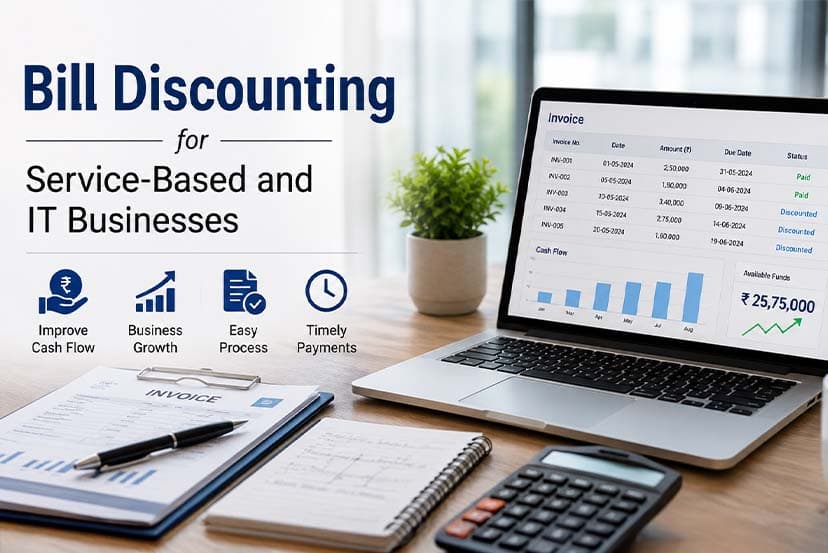
Service-based and IT businesses often complete their work well before receiving customer payments. A software firm can finish a project today and not get paid for 30 or 60 days. Likewise, consulting companies can finish assignments while waiting for the customers to settle their invoices. These payment cycles can put strain on a business’ cash flow, particularly if salaries, vendor payments, software costs, and operating expenses are still due.
Businesses can use Bill Discounting to utilize funds against the outstanding invoices without waiting for their customers to pay. This can be a source of liquidity without requiring businesses to change their customer payment terms. The facility can support daily operations and project implementation for both IT businesses and service providers.
What Is Bill Discounting for Service-Based Businesses?
Bill discounting is a financing method that enables a company to receive cash against acceptable outstanding bills before their due dates. The financing provider refunds the agreed part of the invoice amount, based on the applicable terms and assessment.
In the case of a service company, the underlying invoices may relate to consulting, software development, technology services, managed services, or other contractual work. The arrangement can facilitate the conversion of the receivables into liquid cash so that the customer can continue the payment schedule.
Read More: Invoice Discounting Meaning, Working, and Benefits
Why Service-Based Businesses Face Cash Flow Gaps
Service companies can generate strong revenue while still experiencing temporary liquidity constraints. This happens because revenue recognition and actual customer payments do not always occur at the same time.
- Extended Client Payment Terms
Large customers may negotiate client payment terms extending several weeks after service delivery. While these arrangements can support long-term commercial relationships, they can also increase the period during which funds remain tied up in receivables.
- Recurring Salary and Operating Costs
Recurring costs frequently can be significant for IT and professional service firms. When customers pay their invoices, other accounts such as payroll, cloud infrastructure, software subscriptions, office expenses, contractors, and vendor payments may have to be settled as well. Thus, good cash flow management is essential.
- Project-Based Revenue Cycles
Large technology deployments or consultant projects might have inconsistent revenue flows. Significant money spent during project execution may arise while money paid to the customer might not be received until a milestone or invoice is due.
- Growing Receivables
A growing customer base can substantially increase accounts receivable. Unpaid invoices are considered expected revenue, but they may not be available for immediate use to support operations. Financing against eligible receivables can enable businesses to control these working capital needs better.
How Bill Discounting Works for IT and Service Companies
The workflow is typically based on completed services or qualified invoices. Businesses should check with the provider regarding any specific eligibility requirements before submitting receivables for financing.
- Complete the Service
The business first delivers the contracted service according to the agreed scope and commercial terms. Once the service obligation is fulfilled, the company raises an invoice against the customer.
- Submit Eligible Receivables
The business submits qualifying outstanding invoices along with relevant supporting documentation. The financing provider may assess the invoice, customer, transaction, and underlying commercial relationship before determining eligibility.
- Receive Funds Before the Due Date
Once approved, the provider releases an agreed portion of the eligible invoice value. This gives the business earlier access to liquidity, rather than requiring it to wait until the customer’s original payment date.
- Customer Pays the Invoice
The customer subsequently settles the invoice according to the agreed payment terms. The financing arrangement is then settled based on the applicable structure, charges, and contractual conditions.
Key Benefits of Bill Discounting for IT Businesses
When receivables are guaranteed, companies can avail funds before time; this gives them control over short-term finances. The advantages depend on the business design and also the financing plan.
- Faster Access to Receivables
Businesses can potentially access funds before customers complete their normal payment cycles. This can reduce the amount of time capital remains tied up in unpaid invoices.
- Better Working Capital Control
Better liquidity will enable companies to manage their regular obligations. Businesses have the option to allocate the available funds for payroll, technology systems, vendors, and other operating needs.
- Support for Business Expansion
Growing businesses can benefit from the additional liquidity to take on new projects before previous invoices are paid. Companies can spend the money they have on hiring, investing in technology, projects, or any valid use needed in their operations.
- Easing Cash Flow Stress
Even with healthy revenues, long payment cycles can put a strain on the business for a short time. This benefit can be achieved by improving the time of access to receivables, which can ease the cash flow management process.
- Maintain Existing Client Terms
Businesses may be able to continue offering customers their agreed credit period while accessing funds earlier through eligible receivables. This can help sustain business relationships without having to change customer payment terms right away.
Bill Discounting vs Traditional Business Loans
Both options can provide businesses with access to funds, but their structures are different. Bill discounting is generally linked to eligible receivables, while traditional loans are typically assessed based on the borrower’s overall financial position and credit profile.
| Factor | Bill Discounting | Traditional Business Loan |
| Funding Basis | Eligible invoices | Borrower’s financial and credit profile |
| Funding Purpose | Unlock receivables | Broader business requirements |
| Repayment | Linked to invoice settlement | Usually follows a fixed repayment schedule |
| Funding Cycle | Linked to eligible invoices | Defined loan tenure |
| Suitable For | Businesses with regular invoicing | Businesses requiring broader financing |
Therefore, firms should review the overall financing cost, the payment plan, the eligibility requirements, and the reason for the funding before choosing one.
How Does Credlix Support Businesses with Working Capital?
As a small business expands, it is crucial to manage receivables effectively to ensure proper liquidity. Credlix offers digital financing solutions that enable eligible businesses to access funds based on receivables and to manage their working capital more efficiently.
In the service and IT sectors, prompt access to qualifying invoice payments can ease cash flow pressures, enable project completion, and continue customer obligations. Credlix strives to make financing more accessible through technology-driven processes. It makes the process easier for businesses to improve cash flow and retain financial flexibility.
FAQs
What is Bill discounting for IT businesses?
Bill discounting is a facility that qualified IT companies can avail funds for their outstanding customer bills before the due date. It can assist software firms, IT consultants, and technology service providers with liquidity as customers adhere to payment terms. The availability, funding amount, charges, and eligibility for such financing depend on the financing provider and the particular transaction.
Can service companies use Bill discounting for unpaid invoices?
Eligible service companies may potentially avail benefits of the Bill discounting service for their unpaid bills. Managed service providers, software companies, consulting firms, and other businesses might want to consider this option when they have finished contract work and have invoiceable contracts. Typically, the eligibility requirements are based on the customer’s creditworthiness, documentation of invoices, terms of the transaction, and the provider’s evaluation criteria.
Is Bill discounting different from invoice financing?
Bill Discounting and invoice financing are often referred to as the same thing, but the exact configuration may vary between providers and markets. Both generally involve accessing funds through borrowing that utilizes the assets, in this case outstanding receivables, that are expected to be collected. Businesses must take the time to read the financing agreement to understand the amount of the advance, the charges that will be applied, how they will be repaid, any recourse provisions, and whether they qualify for the financing agreement.