




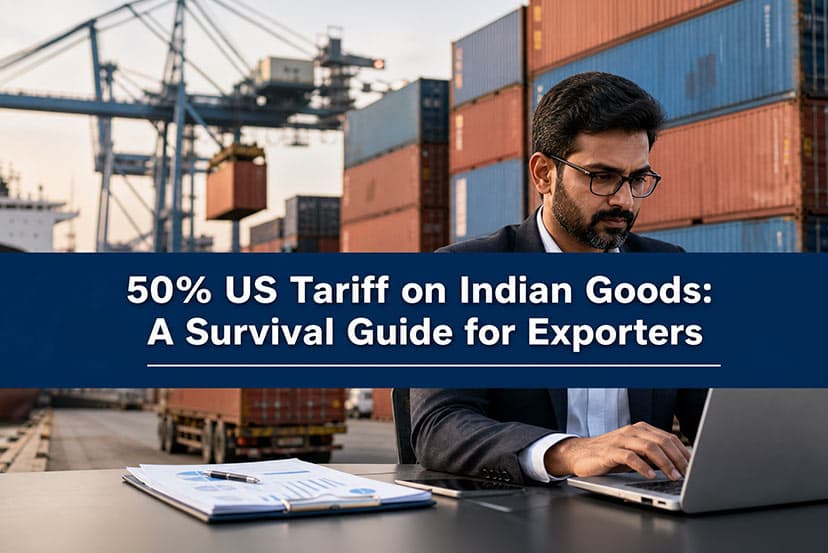
The recent trade disruption, resulting in a dramatic surge in US tariffs on Indian goods, has caused significant uncertainty for Indian exporters across various sectors. The total tariff cost for several Indian exports rose to almost 50% at one point. This affected product pricing, buyer confidence, and export margins in the United States.
The tariff regime has been continuously evolving through negotiations and interim trade agreements. The period of high tariffs showed how vulnerable export businesses can become when geopolitical and trade policy risks escalate.
Tariffs are not the only issue for Indian exporters. In order to survive future trade disruptions, businesses need robust pricing strategies, diversified market planning, liquidity resilience, and smarter working capital management.
Understanding the US Tariff Shock on Indian Exports
This escalation of tariffs started with a series of reciprocated and additional duties imposed on Indian goods by the United States in 2025. In some instances, total tariff exposure grew to nearly 50% for impacted export categories.
Later developments brought tariff relief for some industries via interim trade understandings and legal proceedings. Still, the disruptions had brought a toll on industries heavily reliant on the US market.
This situation identified a number of key risks:
- Reliance on a single export market
- Pricing vulnerability
- Weak margin buffers
- Slow collection of working capital recovery
- Changing geopolitical policy exposure
The tariff shock for many exporters became a trade shock and a liquidity challenge.
Impact Analysis and Survival Strategies Across Different Sectors
Textiles and Apparel Exporters
Key Challenge
There was heavy pricing pressure on the textile and apparel industry due to the ease of obtaining the same products from countries with lower tariffs, like Vietnam or Bangladesh, in the United States.
Survival Strategy
In business, the need of the hour was to:
- Diversify export markets
- Improve cost efficiency
- Renegotiate buyer contracts
- Reduce shipment delays
- Strengthen liquidity planning
Exporters with stronger operational flexibility were generally better at maintaining relationships with the buyers during the period of disruption.
Gems and Jewelery Exporters
Key Challenge
The gems and jewellery industry saw immediate competitive pressure because discretionary consumer categories are very sensitive to price changes.
Recovery roadmap
Most exporters concentrated on:
- Premium product positioning
- Smaller high-margin orders
- Buyer retention strategies
- Alternative market development
Businesses with stronger brand positioning and specialized product segments were less exposed than purely price-driven exporters.
Engineering Goods & Auto Components
Key Challenge
Tariff volatility caused uncertainty for engineering exporters regarding durable contracts and production forecasting.
Stability framework
Several enterprises focused on:
- Regional customer diversification
- Inventory optimization
- Longer-term buyer agreements
- Operational cost control
Overall, exporters of specialized or technically differentiated products were better able to deal with pricing pressures than were commodity-oriented exporters.
Leather and Footwear Exporters
Key Challenge
Global buyers got even more price sensitive amid all the high tariff conditions, leading to a compression in the margin for the leather and footwear sector.
Sustainability strategy
Exporters increasingly explored:
- Value-added product categories
- Non-US market expansion
- Direct-to-brand partnerships
- Faster shipment execution
Businesses that had greater compliance control and design differentiation had higher international buyer confidence.
Chemical and Specialty Product Exporters
Key Challenge
Buyers’ procurement calculations were impacted by the tariffs, causing uncertainty for chemical exporters on landed costs and international contract pricing.
Survival Strategy
Many exporters prioritized:
- Long-term contract stability
- Production efficiency
- Export pricing recalibration
- Customer diversification
Chemical exporters with specialized applications were more resilient in pricing compared to commodity exporters.
Why Working Capital Pressure Became a Major Export Risk
The tariff disruption affected far more than export pricing alone.
As margins tightened, many exporters experienced:
- Delayed receivable cycles
- Inventory accumulation
- Shipment slowdown
- Reduced buyer orders
- Lower production visibility
For MSMEs, this created significant working capital stress because businesses still needed liquidity for:
- Procurement
- Payroll
- Manufacturing
- Logistics
- Shipment execution
Even exporters retaining customer relationships often faced delayed cash conversion cycles because of renegotiated payment terms and slower order movement. This is the reason that tariff disruptions soon became more wide-ranging trade finance challenges.
How Exporters Are Reducing Dependence on Single-Market Risk
Numerous exporters were forced to reconsider long-term market concentration risks from the tariff shock.
Geographic Diversification
To reduce excessive dependence on US demand cycles, businesses increasingly explored:
- Europe
- Middle East
- Latin America
- Southeast Asia
- Africa
Product Diversification
To reduce pure price-based competition, exporters also began expanding into:
- Premium categories
- Value-added products
- Specialized manufacturing segments
Operational Flexibility
Many businesses strengthened:
- Inventory management
- Supplier diversification
- Production planning
- Liquidity reserves
To improve resilience against future trade disruptions. This change is part of a trend towards more balanced export risk management strategies.
How Export Factoring Can Support Exporters During Trade Disruptions
Uncertainty regarding tariffs can lead to liquidity problems for exporters because they may have to wait longer to collect payments and renegotiate contracts.
Export factoring can help businesses:
- Unlock liquidity against export invoices
- Improve receivable cycles
- Reduce working capital pressure
- Maintain production continuity
- Manage operational expenses more efficiently
Instead of waiting through prolonged international payment cycles, exporters can access faster liquidity linked directly to receivables.
This becomes especially important during periods of:
- Pricing instability
- Shipment uncertainty
- Margin compression
- Global trade volatility
For MSMEs, access to flexible trade finance solutions can significantly improve operational stability during uncertain market conditions.
What the Tariff Shock Means for India’s Export Future
The US tariff disruption highlighted how quickly geopolitical and policy shifts can affect global trade competitiveness in real time.
Resilience over time will increase Indian exporters’ reliance on:
- Diversified export markets
- Stronger liquidity management
- Operational adaptability
- Faster financing access
- Value-added manufacturing
Businesses that will continue to be competitive will be able to blend strong customer relationships and flexible financial and operational planning together. The global trade disruptions could continue to change, and exporters with a stronger working capital resilience are better equipped to deal with future uncertainty.
Building More Resilient Export Strategies in an Era of Global Trade Volatility
The recent US tariff shock demonstrated that export competitiveness is no longer driven only by manufacturing capability or pricing efficiency. Financial resilience, market diversification, and liquidity management are all gaining in importance for long-term export sustainability.
Exporters that can adjust rapidly to policy changes and financial pressures will be in a better long-term position when global trade markets change.
Strengthen Export Liquidity with Credlix Trade Finance Solutions
For exporters, financing structures that are more flexible to longer payment cycles and uncertainty are becoming more important in volatile global trade environments.
Credlix helps exporters unlock working capital through export factoring, invoice financing, and collateral-free trade finance for exporters, designed for modern cross-border trade operations. Businesses can streamline shipment cycles, supplier commitments, and cash flow disruptions by having quicker liquidity tied to export receivables. This enables exporters to operate more smoothly even in the case of changing tariff and trade conditions.
FAQs–
- What are the most affected export sectors in India due to the tariff hike by the US?
During tariff escalation, some sectors, such as textiles, gems and jewelry, leather, engineering goods, and certain manufacturing sectors, were exposed to a lot of competitiveness pressure.
- How do higher tariffs affect export working capital?
Increased tariffs can slow down order flow and accelerate receivables–causing further working capital stress for exporters involved in production and shipment activities.
- How can exporters mitigate risk during global trade disruptions?
From market diversification and enhanced liquidity management to operational flexibility and the ability to use faster trade financing solutions are some ways for businesses to improve their resilience