




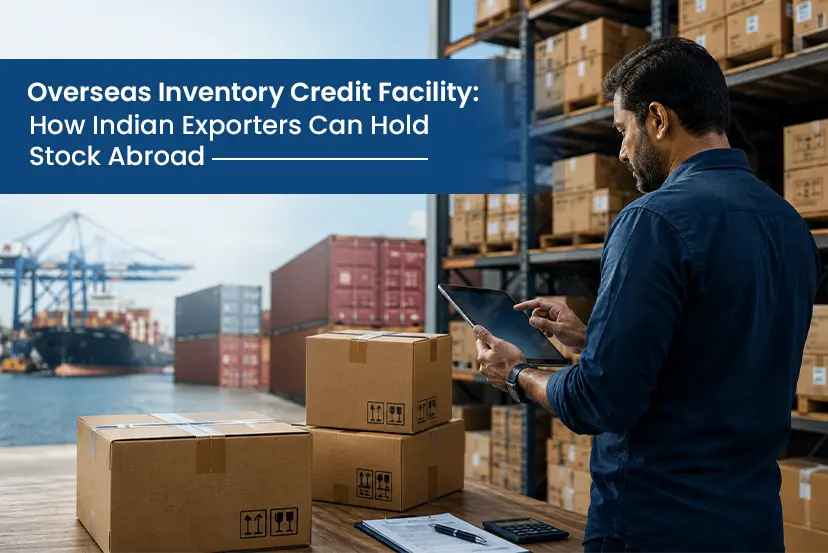
Global buyers today are accustomed to receiving products faster, a quicker fulfillment process and a smoother purchase experience–regardless of the origin of the products. This shift is transforming the way international trade works for Indian exporters. For businesses that depend exclusively on direct shipments from India, it is difficult to manage the high shipping prices and long delivery times along with inconsistent customer experience in overseas markets.
Many exporters are now looking at overseas inventory models to remain competitive, where products can be stored near international buyers. But keeping stocks in foreign countries demands a significant investment of funds, particularly for MSMEs and export businesses that are growing at a fast rate.
This is where an Overseas Inventory Credit Facility comes into the picture. It allows exporters to fund goods held in international warehouses and enhances the fulfillment capacity in the global market without putting a significant strain on operational liquidity.
What is an Overseas Inventory Credit Facility?
An Overseas Inventory Credit Facility is a financing approach that assists exporters in handling foreign stock in overseas fulfillment centers, warehouses, or overseas distribution centres. Exporters can raise their working capital by funding inventory placed overseas before receiving goods receipts.
This funding model is ideal for companies that are doing cross-border ecommerce, overseas distributors, and worldwide fulfillment networks. It enables the exporters to keep international stocks on hand, yet maintain liquidity for procurement, production and expansion requirements.
Why Is Overseas Inventory Becoming Important for Indian Exporters?
The world trade environment prefers exporters who can provide products in a timely and consistent manner. Customers around the world are now demanding delivery times that mirror domestic timelines.
As quicker shipping can boost customer satisfaction and platform performance metrics, local fulfillment systems are preferred by major online marketplaces. Businesses shipping only long distances find it hard to compete with businesses whose inventory is closer to the buyer.
Having overseas inventory stock available also helps alleviate disruptions from customs delays or seasonal logistics issues. This will enhance the reliability of operations and build confidence in international transactions.
A localized inventory presence is no longer a choice, but a strategic advantage for exporters looking to expand their company beyond the local market and grow on the international stage
How Overseas Inventory Financing Actually Works
The Overseas Inventory Credit Facility works on an inventory-linked financing structure.
- Inventory Is Exported To Overseas Warehouses – Exporters send products to overseas fulfilment centres or regional storage centres according to the forecasting of demand patterns.
- Goods Held Closer To International Buyers – Goods are kept near international buyers, and companies’ delivery times are shortened dramatically.
- Financing Is Extended Against Inventory Value – When inventory is stored overseas, the support of financing is provided based on inventory value, which maintains the liquidity of exporters.
- Order Fulfillment Is Done Through Local Distribution Networks – Customer orders are not picked up from India, but through local distribution networks from overseas warehouses.
- Sales From Overseas Support Stock Rotation – Overseas sales revenue supports stock rotation and stock continuity.
It enhances global fulfilment efficiency and inventory-driven scalability.
Operational Advantages of Holding Stock Abroad
For exporters, having international inventory storage may bring about considerable improvements in operations.
- Faster International Deliveries– Overseas warehousing can shorten shipping times, which is important for exporters to keep up with customer expectations regarding order delivery.
- Reduce per-unit logistics costs – Frequent small-shipment costs may be reduced over time with bulk inventory transportation, and shipping costs efficiency is improved.
- Better Marketplace Visibility – E-commerce platforms are prioritizing improving the ranking and visibility of products that are delivered quickly within the local area.
- Lower Seasonal Stockout Risks – Companies can prepare inventory before peak season, rather than wait for it to be sold out.
- Improved Customer Retention – Users enjoy quicker delivery times and smoother order fulfillment which in competitive overseas markets can lead to repeat purchases.
Such benefits make inventory-linked export financing more relevant for the operation of global trade.
Which Export Businesses Benefit Most from Overseas Inventory Financing
- D2C Brands Expanding Internationally– Direct-to-consumer brands can leverage overseas inventory financing to enhance their customer experience and deliver faster to overseas regions.
- Marketplace Sellers with Global Fulfillment Platforms – Companies that sell products through Amazon, Walmart, Etsy or other platforms can benefit from having inventory located locally. Having faster shipping can enhance their marketplace performance metrics.
- Fashion and Lifestyle Exporters – Strategically placed inventory in international markets helps Fashion and Lifestyle Exporters to react to seasonal changes in demand.
- High-frequency Consumer Goods Sellers –Businesses handling repeat purchases and having fast inventory cycles can enhance their operations by maintaining consistent stocks available overseas.
Financial Risks Exporters Must Manage Carefully
The advantages of the overseas inventory model are numerous, but a significant amount of attention needs to be taken to mitigate financial risks.
- A primary concern is the build-up of unsold inventory. If demand is not predicted well, this can result in overstocking overseas warehouses, thus raising storage costs and lowering the liquidity efficiency.
- There is also the possibility that profitability will be affected by exchange rate fluctuations, particularly if inventory costs and sales are in different revenue exchange rate environments.
- Unexpected delays in inventory movement can also add to the pressure on operations with warehousing and fulfillment costs. Businesses need strong inventory planning and demand visibility.
- Inventory ageing risks are especially significant for exporters that are exporting seasonal, trendy or rapidly changing products.
Tackling these issues is imperative to sustaining international inventory financing strategies.
Overseas Inventory Model vs Traditional Export Fulfillment
| Factor | Overseas Inventory Model | Traditional Export Fulfillment |
| Delivery Timelines | Faster local fulfillment | Longer international shipping |
| Customer Experience | More seamless | Delivery uncertainty possible |
| Shipping Structure | Bulk inventory movement | Repeated individual shipments |
| Marketplace Competitiveness | Higher visibility potential | Lower fulfillment preference |
| Inventory Control | Region-specific availability | Centralized inventory management |
This comparison highlights the growing importance of global fulfillment financing for exporters looking to scale internationally.
Why Inventory-linked Financing Matters in Global E-commerce
Fulfillment speed and stock availability are crucial for modern global commerce. Buyers of international marketplaces often prioritize delivery timelines as much as product pricing. For exports operating in competitive categories, keeping inventory near the consumers increases the order conversion rate, customer trust, and repeat purchases. Faster fulfillment also enables businesses to be more effective in seasonal sales cycles and promotional campaigns.
.
For companies that want to grow their businesses abroad without overburdening their internal cash flow, inventory-backed export financing is increasingly emerging as a vital option for trade. With cross-border e-commerce on the rise, inventory-backed export financing is proving to be a key trade tool for companies looking to expand their businesses internationally, but not overtax their internal cash flow.
Exporters who can provide efficient fulfillment and inventory control are going to have a more secure competitive advantage in the coming environment of global trade.
Building Stronger International Fulfillment Networks for Indian Exporters
Indian exporters are shifting from conventional shipment models and are implementing a more localized distribution strategy in the era of fulfillment-centric global trade. Eliminating the need to hold inventory near international customers no longer requires large multinational companies.
By leveraging overseas inventory financing and worldwide fulfillment structures, exporters would be able to enhance competitiveness and build sustainable worldwide development models. Companies that embrace these changing fulfillment expectations in the global market will be more likely to succeed across future export markets.
Expand Global Fulfillment Capabilities with Credlix Trade Finance Solutions
Exporters that have high order volumes or extend into more than one overseas market need a lot of working capital to manage their overseas inventory. Financing arrangements do not necessarily offer the flexibility required to support rapidly changing global fulfillment operations.
Credlix enables exporters to benefit from collateral-free trade finance, export factoring and tailored working capital solutions that fit in the latest international trade cycles. Better access to funding and transaction-linked finance enables companies to manage their overseas inventory growth in a more efficient manner while maintaining healthier liquidity.
This allows exporters to build up fulfillment capacities, enhance the customer delivery experience and grow international operations with increased financial assurance.
FAQs–
- What is an Overseas Inventory Credit Facility?
An Overseas Inventory Credit Facility is a facility that enables exporters to avail financing on inventory that is kept in warehouses or fulfillment centers located overseas.
- Why do exporters maintain stock in overseas warehouses?
Maintaining overseas inventory stock increases delivery timelines, enhances customer experience, and gives marketplace competitiveness in international markets.
- Which businesses benefit most from inventory-linked export financing?
For business entities such as D2C brands, marketplace sellers, fashion export houses, and high-frequency consumer goods companies, inventory-based export financing often proves beneficial