





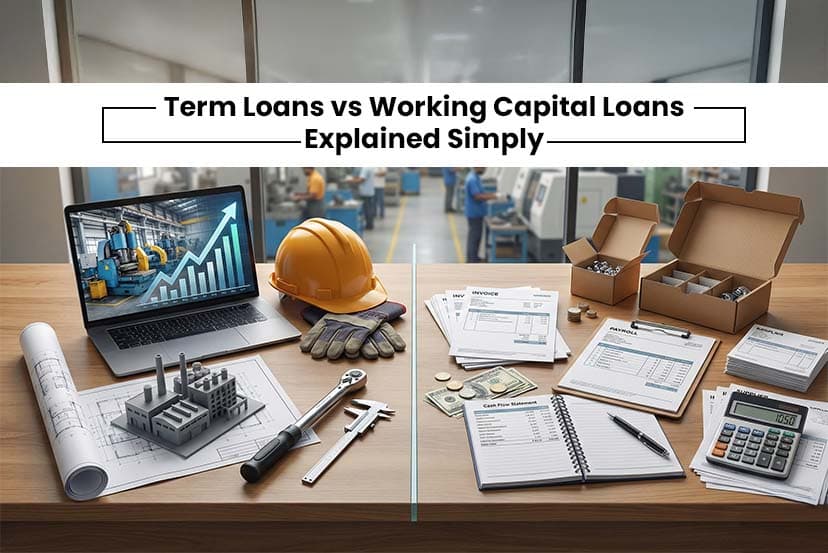
Selecting the appropriate type of business loan can significantly impact cash flow, operational efficiency, and long-term growth. Most companies struggle to differentiate between term loans and working capital loans, as these terms are often used interchangeably, yet they serve distinctly different purposes. It is necessary to understand these financing options when making informed decisions regarding the Working Capital and long-term investments.
This guide gives a practical comparison that can be used by businesses in identifying the loan structure that fits them best.
Overview of Common Business Loan Types
The types of business loans depend on the level of growth, industry, and financial needs. Broadly, the loans may be divided into short-term loans to finance daily activities and long-term loans to finance the creation of assets or growth improvement.
The most widely used sources of financing are term loans and working capital loans. Both of them offer a chance to access funds, but their form, schedules of repayment, and applications are quite different. The incorrect type may strain or restrict cash flows.
Term Loan Meaning and How It Works
A term loan refers to a loan provided for a fixed tenure with a fixed repayment period. Such loans are normally utilized in long-term investments like the acquisition of machinery, expansion of plants, technological advances, and acquisition of businesses.
A business term loan is typically accompanied by:
- Interest rates that are fixed or floating.
- Monthly or quarterly EMIs
- Medium-long-term repayment tenure.
- Collateral or asset backing
As repayments are predictable, term loans fit well in expenses that generate returns in the long run instead of immediate cash flow.
Working Capital Loan Meaning and Its Purpose
A working capital loan is used to finance costs like inventory, salaries, rent, utilities, and shortfalls in receivables.
Working capital financing is designed to rotate quickly as compared to term loans. Businesses will borrow some money, repay, and borrow again, depending on the cycles of cash flow. Such loans are especially significant to those businesses whose demand is seasonal, have a long receivables cycle, or are heavily dependent on inventory.
Working capital loans are also concerned with liquidity and not with the creation of assets.
Difference Between Term Loan and Working Capital Loan
The difference between the term loan and the working capital loan is more about the purpose and form of repayment. Long-term growth initiatives are financed with term loans, and working capital loans are used to maintain the normal operations.
Term loans are fixed tenured and have structured EMIs, in contrast to the working capital loans, which are normally revolving. One of them advocates growth, the other advocates survival. Knowledge of this difference will avoid misuse of money and repayment anxiety.
Term Loans vs Working Capital Loans: Structural Comparison
Comparison of a term loan and a working capital loan shows some of the major structural differences.
- Usage: Long-term investments vs short term working requirements.
- Tenure: Multi-year or short-duration/revolving.
- Repayment: fixed EMIs and flexible repayments.
- Cash Flow Effect: Foreseen outlay and dynamic utilization.
This comparison assists the businesses in matching financing to actual cash flow behavior and not convenience.
Short-Term vs Long-Term Business Loans Explained
The debate is not about whether short-term or long-term business loans are better or not, but which is suitable. Working capital facilities are short-term loans that are effective in dealing with volatility and working gaps.
Term loans are better suited for strategic investment in increasing capacity or efficiency in the long run. Short-term funds are primarily used for long-term needs, which causes a liquidity crunch. Using long-term loans for daily expenses can increase the unnecessary interest burden.
Working Capital and Business Stability
Strong Working Capital ensures that a business can meet its obligations without disruption. Operational problems may occur even in profitable businesses when the incoming and outgoing cash are not matched.
Working capital loans are useful to businesses:
- Manage receivable delays
- Maintain inventory levels
- Prevent interruptions with suppliers’ payments.
- Handle seasonal demand
Businesses might not be in a position to survive without sufficient working capital, although their order books are high.
Which Loan Is Better for Business Growth?
The question of which loan is better for business is all about the objective of the finance. Term loans are more advantageous to businesses that have expansion plans, capacity building, or infrastructural investment plans.
However, working capital financing is required in businesses that have cash flow shortages, holdups in customer payments, or surging orders. A combined ratio of the two types of loan offers the best financial stability and growth.
Choosing the Right Loan Based on Business Needs
The choice of either term loans or working capital loans should be honestly determined by considering the cash flow trends, expansion strategies, and the ability to repay. Businesses should evaluate:
- Nature of expenses
- Timelines of revenue recognition.
- Seasonal variability
- Risk tolerance
The alignment of the loan structure with business reality lowers the financial stress and increases sustainability in the long run.
Aligning Loan Choice with Financial Strategy
Knowing the difference between working capital loans and term loans enables businesses to make wiser financing choices. Whereas term loans favor the growth initiatives that are long-term, Working Capital loans provide continuity, and liquidity in operation. The ability to select the appropriate loan at the appropriate time reinforces cash flow, cushions margins, and sets businesses in line with long-term growth.
Credlix provides businesses with the opportunity to optimize their working capital and trade-related financing needs in a flexible and data-driven way. Credlix allows companies to secure timely funding without strict collateral obligations by emphasizing transaction strength and cash flow cycles. Its strategy enables business stability and also lets the business grow with confidence.
FAQs
Q1: Is it possible to use term loans along with working capital loans?
Yes, most companies take term loans to invest in long-term projects and working capital loans to finance the day-to-day operation.
Q2: Is working capital debt more risky when compared to term debt?
They are not necessarily riskier, but using them incorrectly or having poor cash flow can exert more pressure on repayment.
Q3: What is the best choice for a business between term and working capital loans?
This should be decided on the purpose of funding, anticipated returns, and suitability with cash flow cycles.