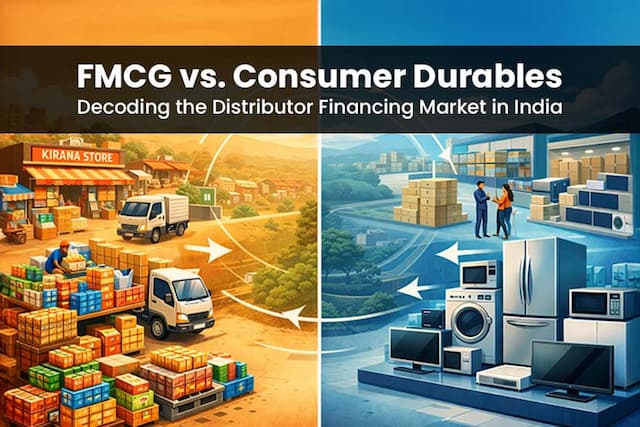





The Fast-Moving Consumer Goods (FMCG) distribution business thrives on speed, volume, and uniformity. Distributors play a crucial role in delivering everyday products to retailers at the right time, in the right quantities, and at the right prices. However, numerous distributors experience constant liquidity strain, despite stable demand. This is where FMCG distributor financing will be a strategic requirement as opposed to a support function.
In dealing with operations that are inventory-intensive, FMCG distributors need financing solutions that move as fast as their products. This guide covers the financial problems that distributors of the FMCG have to overcome. You will also know how stability and development can be promoted by the appropriate funding structures.
Understanding the FMCG Distribution Business Model
The model of the FMCG distribution is quite different compared to a lot of other trading businesses. Distributors acquire goods in large quantities from manufacturers and sell them further to wholesalers, kirana stores, supermarkets and modern retailing chains. The movement of products is swift, whereas the realization of cash is usually late, which creates a structural imbalance.
That is why the working capital for FMCG distributors is under continual tension. Distributors have to pay manufacturers in short durations to sustain supply relationships, while retailers often demand extended credit. Meanwhile, the distributors have to meet daily operational costs in the form of logistics, warehousing, employee wages, and advertising.
Even large volume distributors have little buffer stock when they lack adequate working capital to meet the needs of their volume, giving them stockouts, sale opportunities, and ineffective market presence.
Key Cash Flow Challenges Faced by FMCG Distributors
Unbalanced cash inflow is one of the most prevalent issues in the distribution of FMCG. A combination of factors related to operations and the market causes cash flow management among FMCG distributors to be a problematic task.
The retailers mostly have 30-60 day credit, and longer for large chains in some cases. Demand is seasonal, and thus distributors need to stock heavily, tying up cash in inventory. Trade schemes and discounts usually require initial capital, further straining liquidity.
Furthermore, distributors have to deal with returns of products, expiries, and spoiled products, all of which affect realizable cash. These problems underscore the need to seek outside funding to facilitate the business cycles.
Why Working Capital Is Critical in FMCG Distribution
Sufficient working capital for the distributors of FMCGs will ensure that the supply chains are not disrupted and that the relationships of the retailers are not damaged. With enough liquidity, the distributors will be able to keep their stock levels in optimal positions, change their demand promptly, and negotiate better prices with the manufacturers.
High working capital also enables the distributors to venture into new territories, take on more brands, and cover more retailers without any strain on their operations. Conversely, a lack of liquidity frequently causes distributors to decrease the stock mix or pay late, or even forego expansion possibilities.
The efficiency of the capital turnover determines the long-term sustainability of a business operating in an industry with a low margin.
FMCG Distribution Business Loans: Benefits and Limitations
Traditional business loans are usually used to expand, upgrade infrastructure or long-term requirements. These are loans that are given in a structured form and have foreseeable repayment plans.
They are, however, not necessarily ideal for the daily working capital requirements. The approval processes might take long, collateral requirements are limited, and fixed EMIs do not necessarily match the varying cash flows. This rigidity may be a limitation for distributors that are operating within any volatile demand environment.
This has led to the use of other, less rigid forms of short-term financing by many FMCG distributors to complement conventional loans.
Inventory Financing for FMCG Distributors
Inventory is both an asset and a liquidity issue. The inventory financing for FMCG distributors allows the company to access capital that is tied up in the stock and not liquidated.
In this model, financing will be extended at inventory value, thereby enabling the distributors to buy goods in large quantities whilst maintaining cash reserves. It is useful during seasonal times, like a festival, a promotional event or when a product is being introduced into the market.
Inventory-backed financing lessens the internal cash dependence and ensures the shelves are kept in stock, which has a direct impact on sales continuity.
Trade Finance Solutions in FMCG Distribution
Current trade finance for FMCG distributors focuses on transaction-based financing and is not based on traditional balance sheet lending. These solutions are made to match the financing to real trade.
The structures of trade finance can assist distributors in providing payments to manufacturers within the right time and provide credit to retailers without hindering cash flow. This enhances credibility within the supply chain and enables distributors to obtain improved commercial conditions.
Trade finance can provide scalable liquidity to distributors of FMCGs operating in multiple brands and geographies.
Importance of Short-Term Finance for FMCG Distributors
Since FMCG products are highly dynamic, long-term debt is not as effective as short-term finance for FMCG distributors. The organization of these facilities revolves around inventory cycles, turnover of receivables, and seasonal demand.
Short-term funds are also more accessible and require repayment quickly, and have a smaller interest exposure in the long term. It allows distributors to deal with the shortage of working capital without committing themselves to inflexible commitments.
This is critical in competitive FMCG markets where the ability to respond is key to success.
Supply Chain Finance for FMCG Distributors
Supply chain finance for FMCG distributors enhances the whole ecosystem in aligning the financial interests of manufacturers, distributors, and retailers. These schemes enable advance payments to the supplier as the retailers continue having long credit.
To distributors, this will imply better liquidity without the need to put pressure on suppliers. This helps manufacturers have good cash flows, whereas retailers still get credit support.
These integrated financing models bring about trust and lessen friction, and the overall supply chain effectiveness is also promoted.
FMCG Wholesale Financing Solutions for Scale and Expansion
FMCG wholesale financing solutions are typically needed by large distributors that have high transaction volumes and require specific solutions to deal with multiple brands and regions. These solutions enable large-scale purchases, a larger distribution network, and a portfolio of large retailers.
Financing at wholesale allows distributors to expand operations, penetrate new markets, and handle the peak without stretching their internal resources. It is especially applicable to distributors to the modern trade chains and institutional purchasers.
Choosing the Right FMCG Distributor Working Capital Loan
The choice of an FMCG distributor working capital loan should be based on the keen consideration of the business cycles, repayment ability, and flexibility of funding. Distributors need to emphasize solutions that are in line with sales velocity but not with set schedules.
Among the considerations are ease of access, scalability, low collateral dependency and alignment with inventory and receivable cycle. The right financing partner helps in growth and does not introduce a financial burden.
Financing as a Strategic Advantage for FMCG Distributors
High volumes of sales in the FMCG industry do not necessarily result in financial stability. The FMCG distributor financing is also effective in closing the gap between cash and inventory movement. Through working capital solutions, inventory financing and supply chain finance, the distributors will be able to counter the liquidity limit, fortify their partnership, and use sustainable growth in a competitive market.
Credlix helps the distributors of FMCG to have flexible and transaction-secured financing in accordance with actual trade activity. Credlix enables distributors to access working capital in a productive way, instead of traditional collateral requirements, by presenting invoice strength and supply chain flows, with distributors as the main beneficiaries. Its custom-made financing arrangements back up the inventory cycles, enhance the predictability of cash flow, and enable the distributors to grow operations without straining balance sheets.