




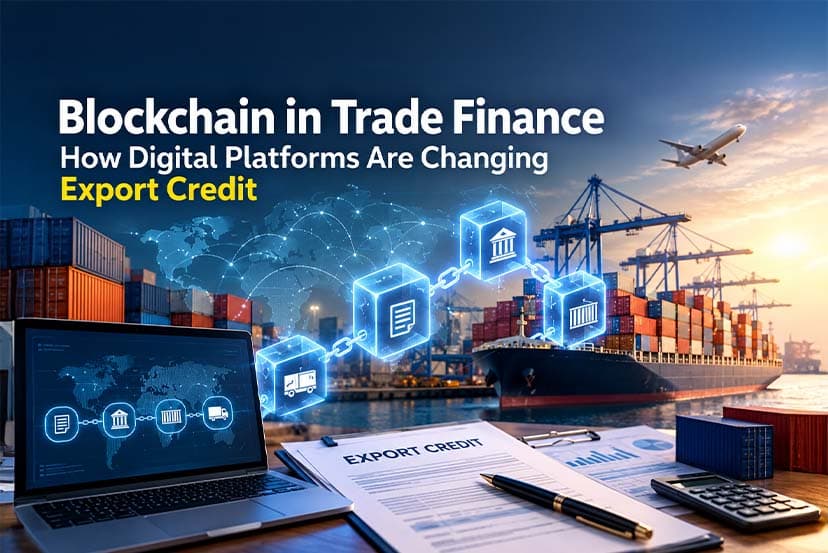
International trade still depends on a large volume of documents exchanged between exporters, importers, banks, logistics providers, customs authorities, and other parties. This can result in more complicated and time-consuming export finance, especially if information needs to be verified in multiple systems.
Blockchain in trade finance is a step towards digital trade finance. Electronic trade documents, connected platforms, and distributed ledgers can enhance the flow and verification of transaction information. However, these technologies don’t eliminate the need for credit evaluation or legal and operational requirements. How well they integrate into the broader trade system is what makes them valuable.
What is Trade Finance?
Trade finance provides financial support for international trade by helping businesses manage payment, credit, and cash-flow risks between buyers and sellers during the period between an export transaction and its settlement.
Why Export Finance Still Relies on Complex Documentation?
A commercial document may contain the following: commercial invoice, bill of lading, a purchase order, certificates, customs documentation, insurance documentation, payment instructions. These records might be required by banks and other financial institutions before they give export credit.
The problem isn’t just volume; it’s finding, tracking, and using that information. Information can pass through multiple organizations and various systems, so that it can be duplicated, checked manually and left open to inconsistencies. Information asymmetry, paper-intensive processes and the low degree of connectivity between trade platforms are significant obstacles to streamlining export finance.
Read: Commercial Invoice Meaning, Working, and Benefits
How Blockchain Changes the Trade-Finance Process?
Blockchain is a type of distributed ledger technology that enables the sharing of transaction records between authorized participants, instead of depending on separate databases. This can help to maintain a more uniform and accurate documentation of the transaction details of interested parties in blockchain trade finance.
Document verification is a function that can be supported with a shared ledger, as everyone can use a set of documents which are synchronized across the ledger. This can help to minimize duplication involved in checking information in different systems.
Smart contracts can automate predefined actions, including triggering payment once a valid bill of lading is recorded on the ledger. But blockchain is not intended to replace lender due diligence, credit evaluation, regulatory screening, or the requirement for due diligence as to the underlying information of the trade.
From Digital Trade Documents to Faster Credit Decisions
A financier must have sufficient information to evaluate the financing, the parties and the risks involved when an exporter applies for financing. Relevant information can be more easily accessed and processed with a digitized record.
Digital trade documents can supplement the blockchain-based infrastructure here. Digitization of trade documents, digital identity and alternative data can contribute to overcoming information barriers and to enable more efficient credit assessment, especially in the case of smaller businesses.
Electronic Bills of Lading Are Changing Trade Documentation
One of the most obvious examples of paperless trade is the electronic bill of lading or eBL. Where the legal and technical framework allows, instead of transferring a physical document between parties, an electronic, transferable record can be created, controlled, and transferred electronically.
This can provide:
- More efficient handling of trade documentation.
- The transaction information is more readily accessible.
- Reduced reliance on paper and hard copy documentation
Legal recognition and interoperability are two of the key conditions for wider eBL adoption. The UNCITRAL Model Law on Electronic Transferable Records (MLETR) defines functional equivalence between electronic and paper records, and implementation will require appropriate national legislation.
Where Blockchain Adds Value for Exporters and Financiers
- Document verification: Shared records can provide a consistent source of transaction information for authorized participants, which can help to minimize discrepancies between records.
- Visibility of transactions: A connected blockchain can enhance visibility of relevant transaction events and documents in the trade finance environment.
- Trade finance automation: Smart contracts can trigger preprogrammed actions in response to agreed conditions, aiding in trade finance automation.
- Consistency of information: Common digital records can cut down on the necessity of comparing the same information with several isolated systems.
What Still Limits Blockchain Adoption in Trade Finance
Blockchain itself can’t fix broken trade systems. Below are some key factors that influence how digital trade infrastructure can operate effectively at scale.
- Interoperability: Exchange of information must be reliable across different platforms.
- Common standards: Participants must have shared data formats and processes.
- Legal status: Appropriate legal status in relevant jurisdictions for electronic records.
- Industry participation: Benefits increase when banks, exporters, carriers, customs authorities, and other stakeholders participate.
- Data governance: Participants should be provided with rules for access to the data, identity of the data, security of the data, and who is responsible for using it.
What Digital Trade Platforms Mean for Indian Exporters
India is also making strides to become a more digital trade ecosystem. In February, 2026, DGFT released a proposed Digital Trade Facilitations Bill, 2026, which comprises provisions relating to the legal recognition of electronic trade documents, digital identity, trust services and cross-border recognition of digital trade records. The proposal is meant to create a framework and is not a law that is currently in effect.
The developments of this kind may prove beneficial to Indian exporters for smoother documentation and information-sharing processes and for digitalization in cross-border trade. More networked systems may also support the application of relevant transaction information in export financing processes more easily over time.
Building a More Connected Export Finance Ecosystem With Credlix
Digitalization ultimately means a financial benefit for exporters when it’s useful for them in actual practice. Export factoring with Credlix provides working capital to exporters without having to go through the full payment process of the buyer. Funding of up to 90% of the invoice value may be available, subject to eligibility and applicable terms.
This is a different, but related component of the export process, converting unpaid balances into working capital. By helping exporters access funds against eligible export invoices, Credlix can help businesses manage cash flow while waiting for overseas buyers to make payment.
Connecting Digital Trade With Export Working Capital
There can be a time lag for exporters to get paid by an overseas buyer after goods have been shipped. One way to secure financing for this is export receivables financing, which can be facilitated through funds against eligible receivables.
Digital trade infrastructure can simplify the knowledge of transactions, and financing providers will continue to evaluate the underlying receivables, buyer, transaction and relevant risk.
FAQs
How is blockchain used in trade finance?
Blockchain can provide a shared record of transaction information among authorized participants. This can facilitate document verification, enhance information visibility and automate smart contracts in trade finance. Distributed ledger technology is one of the key potential solutions for streamlining parts of the trade finance business that are traditionally paper-based.
Can blockchain make export credit faster?
While blockchain can make export credit faster, it does not ensure that the credit is guaranteed. Some administrative and verification tasks can be minimized, however, with shared digital records, electronic documents and automated workflows. Final funding approval is subject to the lender’s evaluation of the transaction, borrower, documentation, and the applicable risk requirements.
What are the main challenges of blockchain in trade finance?
The key challenges are interoperability between platforms, common standards, legal recognition of electronic records, industry participation and data governance. In its digital trade work, the ICC highlights that technology is not enough. There also need to be rules, trusted systems and cross-border legal frameworks that are compatible to enable a functional digital trade finance ecosystem.