




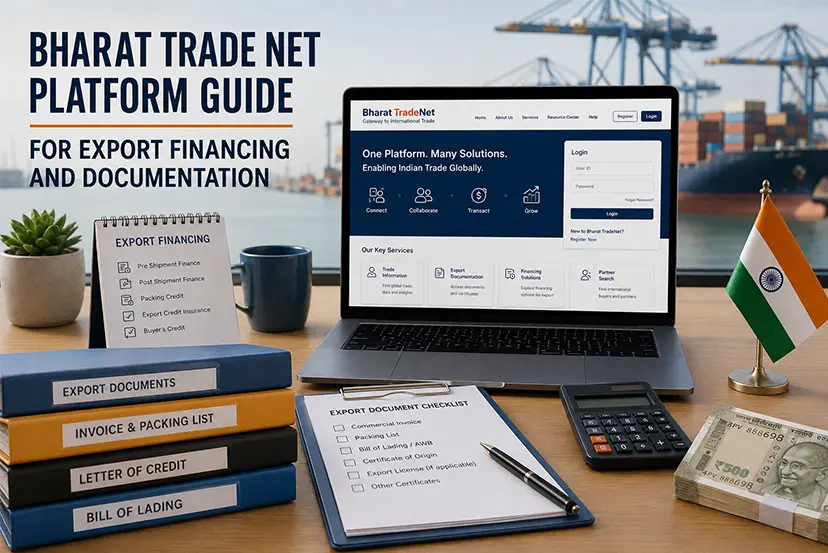
India’s export ecosystem still involves multiple systems, documents, and stakeholders. BharatTradeNet (BTN) has been proposed to address this fragmentation through a unified digital public infrastructure for international trade.
Announced in the Union Budget 2025-26, BTN is intended to provide a unified platform for trade documentation and financing solutions while complementing the Unified Logistics Interface Platform.
For exporters, it brings documentation and access to trade finance closer together within a digitally connected ecosystem.
What Is BharatTradeNet?
BharatTradeNet is a proposed digital public infrastructure designed to simplify international trade processes. Its stated purpose is to provide a unified platform for trade documentation and financing solutions.
The initiative is part of India’s broader effort to make trade processes more digital, interoperable, and efficient. It is particularly relevant to MSME exporters that often manage documentation and financing across different institutions.
Importantly, BTN should not currently be treated as an operational replacement for existing export systems. Government documents indicate that the initiative and its supporting framework are still being developed.
Read: Trade Finance Meaning, Working, and Benefits
Why Exporters Need a More Connected Trade Platform
An export transaction can involve customs, DGFT, banks, logistics providers, regulatory authorities, and overseas buyers.
The information required for these processes can therefore spread across different systems. This creates additional administrative work and increases the possibility of inconsistent or duplicated information.
BTN is intended to address this fragmentation by creating a more integrated digital framework for trade documentation and financing. The government’s stated objective is to simplify trade processes and improve the efficiency of international transactions.
For exporters, the potential benefit goes beyond simply having another digital portal. It is better connectivity between the information required to complete a trade transaction.
How Could BharatTradeNet Transform Export Documentation?
Documentation is one of the most significant components of international trade. Depending on the transaction, exporters may deal with commercial invoices, packing lists, shipping documents, certificates, bank records, and other regulatory documentation.
BTN is being developed with the broader objective of supporting digital trade documentation and improving interoperability. A draft Digital Trade Facilitation Bill, released by DGFT in February 2026 for stakeholder comments, specifically addressed statutory recognition of electronic trade documents and trusted digital verification mechanisms.
This legal framework is important because digital trade requires more than simply converting paper documents into electronic files. Documents must also be capable of being trusted, verified, and exchanged across systems.
What BTN Means for Export Financing?
The financing component makes BTN particularly relevant to exporters. The Union Budget specifically described BharatTradeNet as a platform for both trade documentation and financing solutions.
This creates the possibility of connecting trade-related information with financing processes more efficiently.
For example, verified transaction information could potentially help financial institutions assess an exporter’s financing requirements using more structured trade data.
However, exporters should not interpret BTN as an automatic loan or credit facility. The platform’s announcement does not mean that financing will automatically be approved through BTN. Actual financing will continue to depend on the relevant financial institution, transaction, borrower profile, documentation, and applicable lending requirements.
The Potential Impact on MSME Export Finance
Access to working capital can be particularly important for MSME exporters managing production and shipment costs before receiving payment from overseas buyers.
A more connected digital trade environment could make it easier for lenders to access relevant transaction information and evaluate financing requirements.
The Export Promotion Mission also separately focuses on improving access to affordable trade finance for MSMEs. It does so through instruments including interest subvention, export factoring, collateral support, and other credit-enhancement measures.
BTN should therefore be viewed as part of a wider shift toward digitized, more accessible export finance, rather than as a standalone lending scheme.
How Documentation and Financing Connect
The real value of Bharat Trade Net for exporters lies in the potential connection between trade activity and financial decision-making.
A simplified export journey could involve:
- Order
- Documentation
- Shipment
- Trade Data
- Financing Assessment
- Export Proceeds
The purpose is not to eliminate every existing process. Instead, greater interoperability could reduce the need to repeatedly provide or reconcile the same information across disconnected systems.
This could be particularly valuable for businesses handling frequent export transactions and large volumes of documentation.
What Exporters Should Continue Using Today?
BTN does not eliminate the need to follow existing export procedures. Exporters should continue using the applicable DGFT, customs, banking, GST, and other regulatory systems until BTN-related functionality is formally operationalised.
For example, exporters still need to maintain the registrations, authorisations, shipping documentation, and banking arrangements applicable to their transactions.
The government has also continued developing other digital trade initiatives. DGFT’s Trade Connect ePlatform, for instance, provides exporters with trade-related information and connects them with relevant trade institutions.
Therefore, exporters should distinguish between existing operational platforms and the future capabilities proposed under BTN.
Preparing Your Business for BharatTradeNet
Exporters can prepare by improving the quality and consistency of their existing trade records. This includes keeping core business and export documentation accurate, maintaining proper banking records, and ensuring transaction data is consistently recorded across relevant systems.
Businesses should also understand their financing requirements before seeking export credit. A clear view of order values, production costs, shipment schedules, receivables, and repayment sources can help them approach financing more effectively. Preparation today can make future digital workflows easier to adopt.
What Exporters Should Watch Before BTN Goes Live
- As BTN is still evolving, exporters should avoid relying on unofficial claims about specific features, registration procedures, financing approvals, or launch dates.
- The draft digital trade facilitation bill released in 2026 shows that the legal framework supporting electronic trade documentation is still being developed.
- The government has also stated that the specific schemes to be covered under BTN and their implementation timeline were still under consultation.
- Exporters should therefore follow official DGFT and Ministry of Commerce announcements before changing their existing compliance or financing processes.
Turning Digital Trade Data Into Better Finance Decisions
The future of export finance will increasingly depend on how efficiently businesses can connect transaction data with financing requirements.
Credlix focuses on digital trade-finance solutions that help eligible businesses address working-capital requirements linked to their trade cycles. As India’s trade ecosystem becomes more digitally connected, reliable transaction data can play an increasingly important role in helping businesses evaluate and manage their financing needs.
For exporters, the larger opportunity is not simply faster documentation. It is building a more connected trade-finance ecosystem where documentation, transactions, and financing decisions work together more efficiently.
FAQs
What is Bharat Trade Net used for?
BharatTradeNet has been proposed as a unified digital public infrastructure for international trade, focused on trade documentation and financing solutions. It is intended to improve the integration and efficiency of trade processes. However, exporters should continue following existing systems and requirements until specific BTN functionalities are officially operationalised.
Will BharatTradeNet provide export loans automatically?
No. BTN has been proposed as an infrastructure platform for trade documentation and financing solutions, not as an automatic loan-approval system. Financing decisions will remain subject to applicable lender policies, borrower eligibility, transaction details, documentation, and other relevant requirements.
Is BharatTradeNet currently available for exporters?
Exporters should not assume that BTN is currently available as a fully operational public platform. Government information indicates that its framework and supporting digital and legal infrastructure are still being developed. Exporters should continue using existing DGFT, customs, banking, and other prescribed systems until official implementation details are announced.